

DroneNexus
Ground Control Station & Virtual Environment
Role
Full-Stack Developer
Duration
2025
Team
Solo
Status
Shipped
Overview
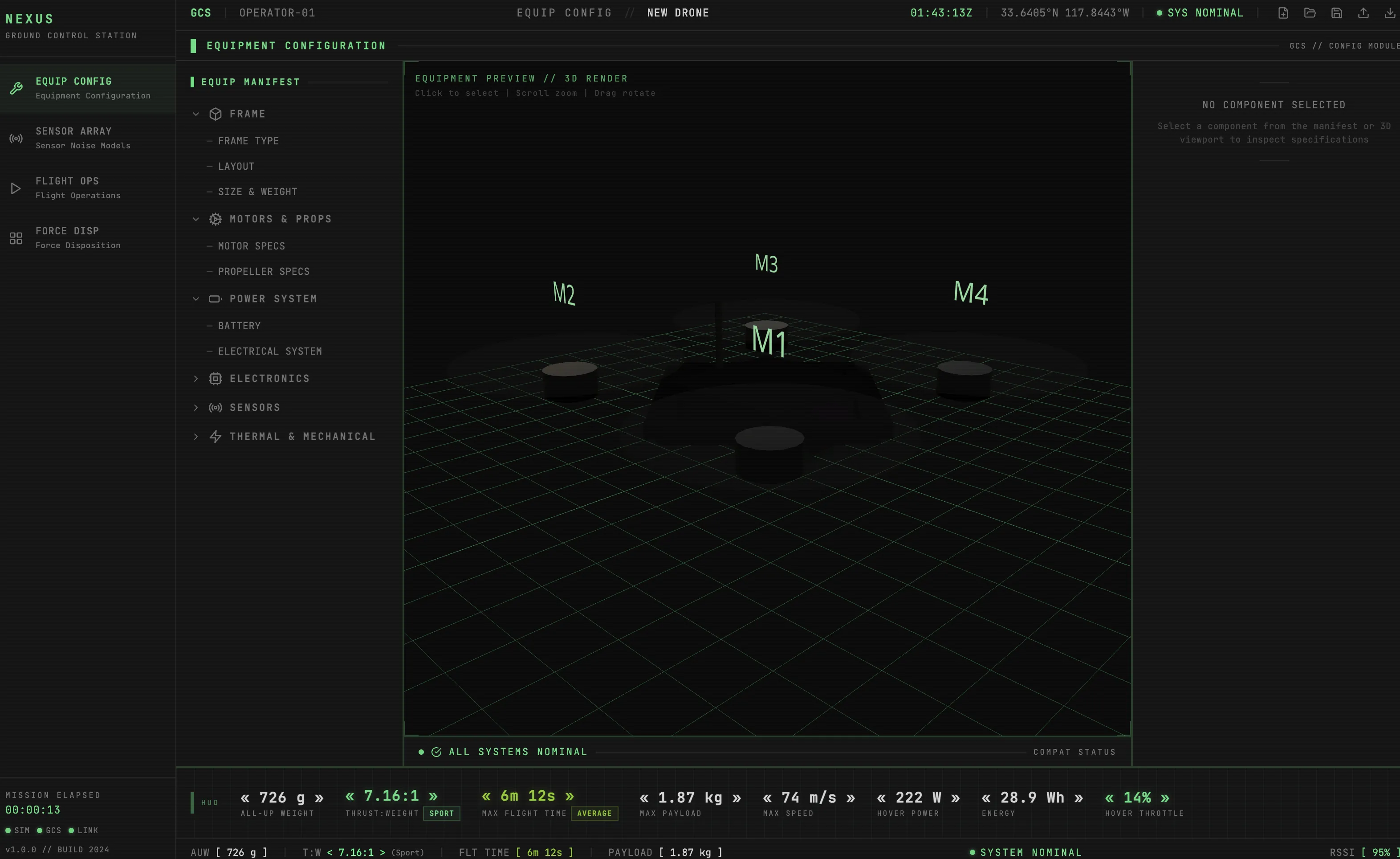
Configuring drone hardware is currently a spreadsheet exercise. Operators cross-reference spec sheets, run thrust calculations by hand, and discover incompatibilities after the build is assembled. I built a virtual environment where every component, from frame, motors, and propellers to power system, electronics, sensors, and thermal, lives in a single interface with a 3D preview and real-time performance calculations. Swap a motor and instantly see how it changes thrust-to-weight ratio, max flight time, and hover power draw. The system catches incompatibilities before anything gets bolted together.
Problem
Hardware configuration for multi-rotor platforms involves six interdependent subsystems. Changing the motor changes the prop clearance, the power draw, the thrust curve, the flight envelope, and the thermal profile. Operators currently manage this across separate spec sheets, Excel calculators, and manufacturer tools that do not share data. Incompatibilities surface during assembly or, worse, during flight. There is no unified environment where an operator can see how one component choice ripples across every performance metric.
Approach
- 01Built a 3D equipment preview in Three.js: click to select, scroll to zoom, drag to rotate. Operators see the physical platform update as they swap components
- 02Designed an equipment manifest tree spanning six subsystem categories: Frame, Motors & Props, Power System, Electronics, Sensors, Thermal. Each category exposes every configurable parameter
- 03Implemented real-time performance calculations that recompute on every component change: all-up weight, thrust-to-weight ratio, max flight time, max payload, max speed, hover power, energy consumption, and hover throttle percentage
- 04Added sensor noise modeling for simulation-grade parameter estimation, so operators can preview sensor behavior before flight
- 05Built a force disposition view for multi-drone tactical planning. Operators see the full fleet, not just one platform
Design Decisions
Technology Stack
Frontend
3D
Simulation
Architecture
Next Case Study
VA.gov MVP↗